
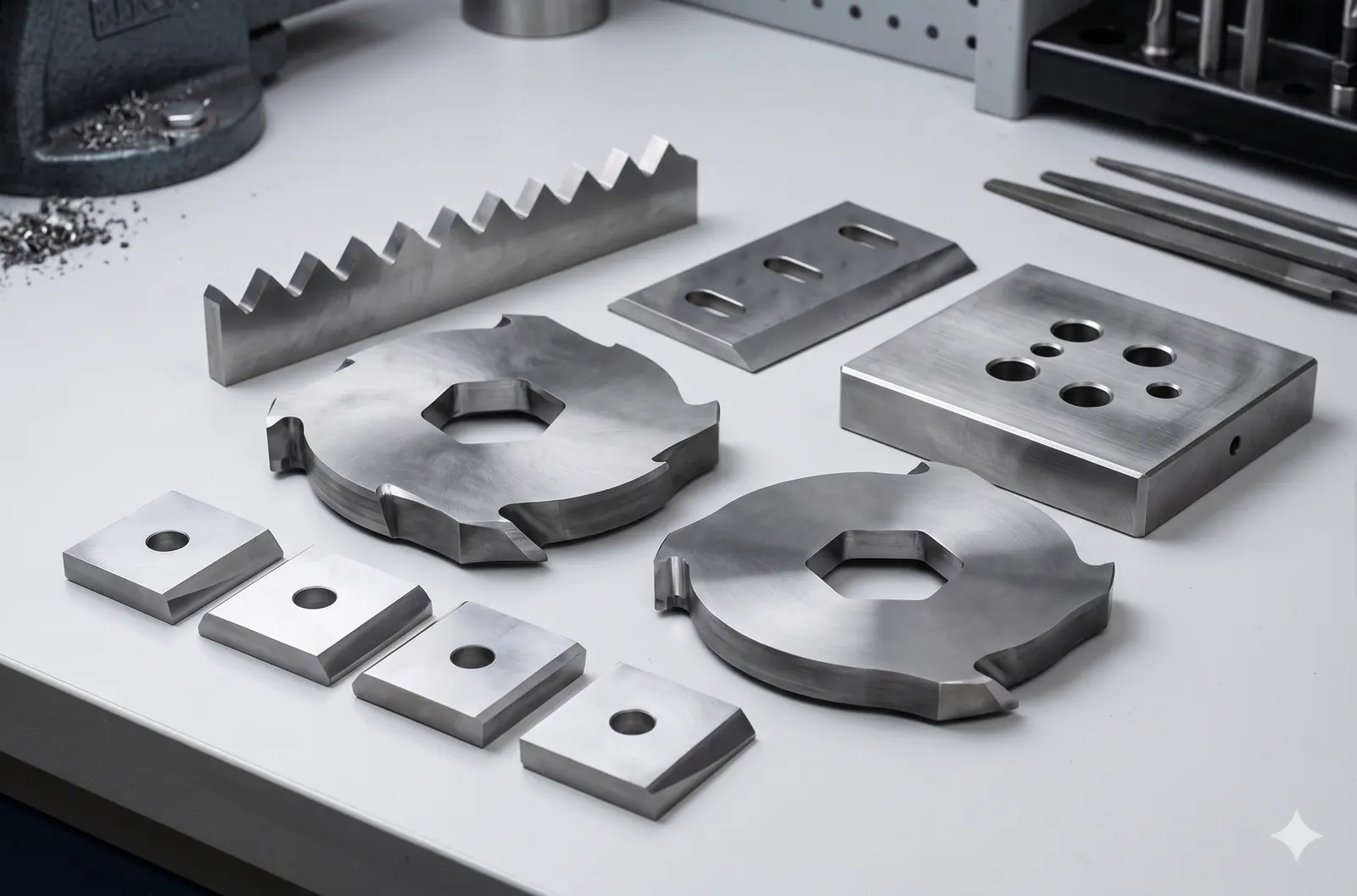
Material expertise
Materials and heat treatment for recycling knives
Service life isn't born in a catalogue, but in the right combination of material grade, heat treatment and load case. We select tool steel, alloy steel or carbide specifically by the impact, pressure and abrasion load of your application.
Which materials are used for recycling knives? For recycling knives, ripper teeth and wear parts, the main materials are cold-work and hot-work tool steels, high-speed steel (HSS), tough alloyed quenched-and-tempered steels and carbide-tipped special designs. The choice depends on impact load, abrasion, temperature and the desired service life – not on a single "universal material".
Material groups
Tool steel, quenched-and-tempered steel and carbide at a glance
| Material group | Typical property | Typical use |
|---|---|---|
| Cold-work steel (e.g. 1.2842, 1.2379) | High wear resistance, good cutting retention | Shredder knives, granulator blades, shear blades |
| Hot-work steel (e.g. 1.2344) | Tough, temper-resistant, impact-resistant | Ripper teeth, heavily impact-loaded components |
| High-speed steel / HSS (e.g. 1.3343) | Very high hardness and cutting retention | Granulator blades with high service-life demands |
| Alloyed Q&T steel (e.g. 1.6582, 1.2766) | High toughness, impact-resistant, less wear-resistant | Ripper teeth, hammers, impact-loaded holders |
| Carbide (tungsten carbide) | Extreme abrasion resistance, more brittle than steel | Cutting inserts for highly abrasive material |
Material numbers serve for classification and must be agreed in detail per application – the binding step is technical clarification in each individual case.
Heat treatment
Hardening, tempering and case hardening combined correctly
Heat treatment decides whether a material keeps its strength under operating load. The key is always the compromise between hardness and toughness – maximum hardness does not automatically mean maximum service life.
- Hardening & tempering: set the base structure to target hardness and reduce brittleness
- Multiple tempering: for high dimensional stability and reproducible hardness values
- Case / induction hardening: a hard cutting edge with a tough core
- Typical hardness ranges: approx. 54–62 HRC, depending on application and material
Selection guide
Which load case calls for which approach?
| Load case | Recommendation |
|---|---|
| High impact share, many foreign objects | Tougher material, more moderate hardness, focus on chipping resistance |
| Pure abrasion, uniform material | Highly wear-resistant material or carbide, higher hardness |
| Changing material types | Balanced material with a good toughness-hardness balance |
| Very high repeat requirement | Standardised material for predictable framework pricing |
Unsure which material fits?
We recommend material and heat treatment – you don't have to know it yourself
Tell us the machine, the feed material and your previous service-life experience. If known, details on material and hardness are welcome – but they aren't required.
Request material advice